

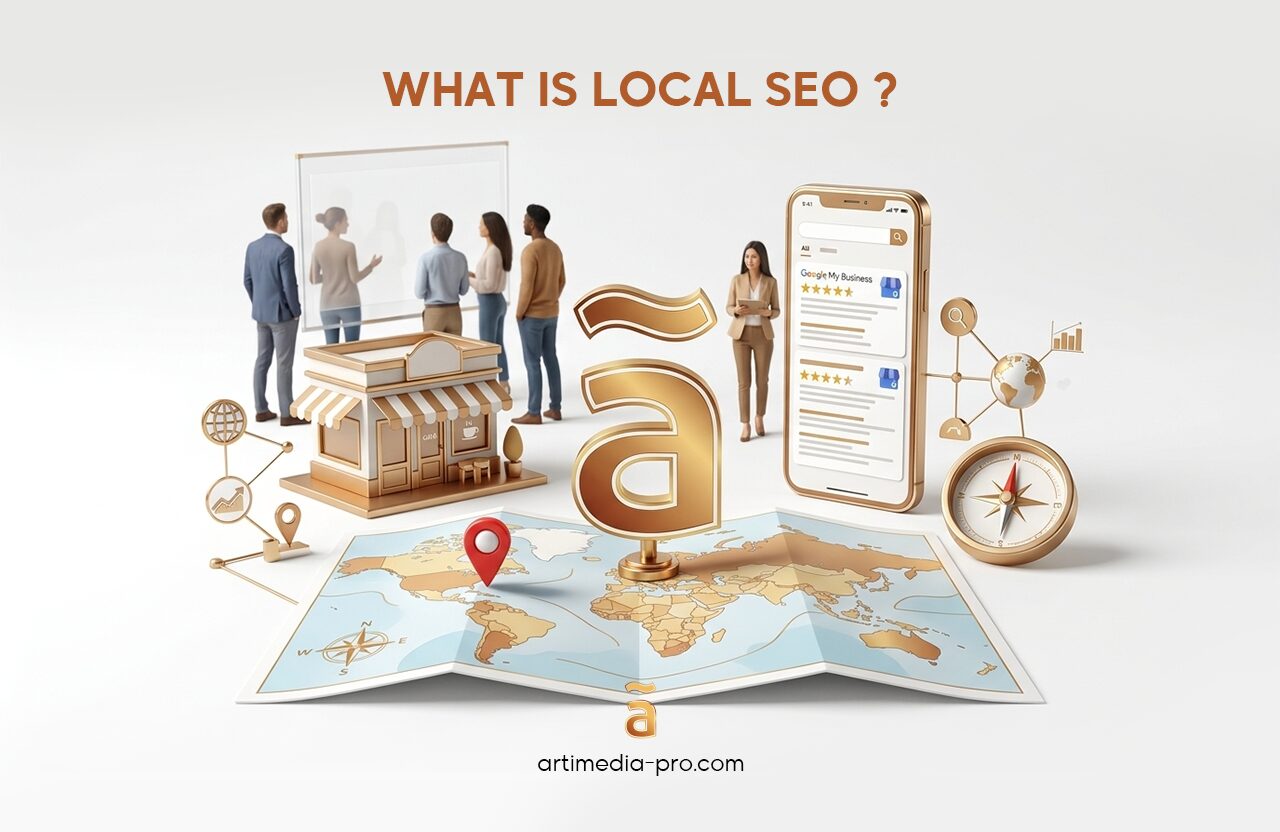

Right now, someone in your city is typing “best [your service] near me” into Google. In the next 24 hours, 76% of people who perform that exact search will visit a physical business. And 28% of those visits will end in a purchase — today.
Local SEO strategy is the practice of making your business visible to the people who are closest to you and most ready to buy. In 2026, it has become the highest-ROI digital marketing strategy for small businesses, startups, and service providers. With Google processing approximately 97 billion local searches every month, being invisible is no longer an option.
1. What Is Local SEO? A Clear Definition
Local SEO (Local Search Engine Optimization) is the process of optimizing your online presence to increase visibility in location-based search results. It tells search engines: this business exists, it operates here, and it serves customers in this specific geography.
When a user searches for a “coffee shop near me” or “dentist in Dubai,” Local SEO determines which businesses appear. It relies on geographic relevance signals like your verified address, local citations, and proximity to the user. Since 46% of all Google searches have local intent, this strategy is the bridge between online browsing and physical foot traffic.
+2
2. Local SEO vs. Regular SEO: What’s the Difference?
While they share foundational principles, their focus and ranking factors differ significantly:
| Factor | Regular SEO | Local SEO |
| Goal | Rank for broad, global keywords | Rank for location-specific searches |
| Target Audience | National or global users | People in a specific city or region |
| Key Signals | Content quality, backlinks | Google Business Profile, Reviews, NAP |
| SERP Feature | Organic blue links | Local Pack (Map + 3 Businesses) |
| NAP Consistency | Not a factor | Critical ranking signal |
3. Why Local SEO Matters More Than Ever in 2026
The data case for Local SEO in 2026 is undeniable:
- Massive Volume: Google processes ~3.2 billion local searches per day.
- High Conversion: 80% of local mobile searches convert into customers.
- The Competitive Gap: 58% of businesses still don’t optimize for local search, leaving a massive window of opportunity for those who do.
- Mobile Dominance: Over 60% of searches happen on mobile, where “near me” results dominate the screen.
4. How Google Ranks Local Results: The 3 Core Factors
 Relevance
Relevance refers to how well your business matches what the user is searching for.
How it works:
When someone searches for something like “best coffee shop”, Google tries to show businesses that clearly identify as coffee shops—not just any restaurant.
How to improve it:
Complete your Google Business Profile fully
Use accurate business categories (e.g., “Dentist” vs. “Cosmetic Dentist”)
Add detailed descriptions with keywords your customers actually search
Include services, products, and FAQs
The clearer you are about what you offer, the easier it is for Google to match you with searches.
Distance
Distance measures how far your business is from the searcher’s location (or the location they specify).
How it works:
If someone searches “gym near me,” Google prioritizes nearby gyms
If they search “gym in Amsterdam,” results will center around Amsterdam
Important notes:
You can’t directly control distance
But you can optimize your presence in a specific area
How to work with it:
Add your correct address and service areas
Use location-based keywords (e.g., “plumber in Amsterdam”)
Create location-specific pages on your website
Prominence
Prominence is about how well-known and trusted your business is—both online and offline.
What influences it:
Customer reviews (quantity + quality)
Backlinks from other websites
Listings in directories (citations)
Mentions in media or blogs
Overall brand reputation
Example:
A well-known restaurant with hundreds of good reviews will usually rank higher than a new one with few reviews—even if both are equally close.
How to improve it:
Encourage happy customers to leave reviews
Respond to reviews (positive and negative)
Build backlinks from local websites
Stay active online (posts, updates, photos)
Key Takeaway
Google balances these three factors together:
A highly relevant business far away might lose to a closer one
A very prominent business can sometimes outrank closer competitors
The best results usually combine all three
5. The Google Local Pack: The “Holy Grail”
The Local Pack (or 3-Pack) is the block of three business listings that appears at the top of Google for local queries.
- It appears for 93% of local intent searches.
- Businesses in the Local Pack get 44% of all clicks on the page.
- It provides a 126% traffic advantage over results ranked just below it.
6. The 8 Pillars of a Complete Local SEO Strategy
Pillar 1: Google Business Profile (GBP)
Your GBP is your digital storefront. It must be verified, categorized correctly, and updated weekly with photos and posts.
Pillar 2: Review Management
Reviews are a direct ranking factor. 93% of consumers say reviews affect their buying decisions. A high rating and frequent responses are essential.
Pillar 3: NAP Consistency
Your Name, Address, and Phone number must be identical across all directories (Yelp, Yellow Pages, etc.) to build trust with Google’s algorithm.
Pillar 4: On-Page Local SEO
Include your city/region in Title Tags, Meta Descriptions, and H1 headers. Use LocalBusiness Schema markup for technical clarity.
Pillar 5: Local Content
Create blog posts or guides specific to your area (e.g., “Top 10 Interior Design Trends in Riyadh”).
Pillar 6: Local Link Building
Get links from local newspapers, chambers of commerce, or partner businesses in your city.
Pillar 7: Voice Search Optimization
58% of consumers use voice search. Optimize for conversational questions like “Where is the closest marketing agency?”
Pillar 8: Analytics
Track direction requests, phone calls, and website clicks via your GBP Insights dashboard.
7. Local SEO for Small Business: Tactics That Work

1. Claim Your Profile (Free but Powerful)
Start by claiming and verifying your business on Google Business Profile—this is the foundation of local SEO.
Why it matters:
If you don’t control your listing, you’re missing a major ranking opportunity.
What “complete your profile” really means:
Fill in business name, address, phone (NAP consistency)
Choose the right primary and secondary categories
Add business hours (including holidays)
Write a keyword-rich business description
List all services/products
Enable messaging if relevant
Photos (very important):
Adding 10+ high-quality photos can significantly boost engagement:
Exterior (so customers recognize your location)
Interior (build trust)
Team photos (human connection)
Products/services in action
Businesses with active, complete profiles tend to rank higher and get more clicks.
2. Ask for Reviews (Smart Timing Wins)
Reviews are one of the strongest prominence signals in Google’s ranking system.
Best strategy:
Ask for a review immediately after a positive experience—timing is everything.
Why WhatsApp works well:
Using WhatsApp makes it:
Personal
Fast
Easy for the customer to act
How to do it effectively:
Send a direct review link (no friction)
Keep the message short and friendly
Personalize it with the customer’s name
Pro tips:
Don’t buy fake reviews (Google can detect this)
Always reply to reviews (this boosts trust + engagement)
Aim for consistent review growth, not just a one-time spike
3. Hyper-Local Pages (Neighborhood Targeting)
Creating location-specific landing pages helps you rank in multiple nearby areas—not just your main city.
What it means:
Instead of one generic page, you create pages like:
“Plumber in Downtown”
“Plumber in West District”
“Plumber near [Neighborhood Name]”
Example:
If you’re targeting areas around Amsterdam, you might create:
“Electrician in Amsterdam Noord”
“Electrician in De Pijp”
“Electrician in Oud-West”
What to include on each page:
Unique content (don’t copy-paste!)
Local keywords (neighborhood names)
Real photos from that area if possible
Customer testimonials from that location
Embedded Google Map
Why it works:
Google sees you as relevant to multiple micro-locations, increasing your visibility in “near me” searches.
8. How to Choose a Local SEO Agency
Look for partners who:
- Focus on business outcomes (calls/leads) rather than just rankings.
- Have deep knowledge of your specific geographic market.
- Are transparent about their methodology and timelines (expect 3-6 months for major results).
9. Local SEO Trends Shaping 2026
- AI Overviews: Google’s AI now answers local queries directly using GBP data.
- Chatbot Discovery: ChatGPT Search is increasingly used to find local businesses.
- Video Reviews: 76% of users now prefer watching video reviews over reading text.
10. The MENA & Syria Local SEO Opportunity
In regions like Syria, Lebanon, and Saudi Arabia, Local SEO is an untapped goldmine:
- Arabic Search: Most businesses ignore Arabic keywords, leaving a massive opening for those who optimize in the local language.
- WhatsApp Integration: The MENA region is mobile-first. Connecting WhatsApp to your GBP can drastically increase conversion rates.
- Early Advantage: In markets like Syria, establishing local authority now ensures dominance before the market becomes saturated.
FAQs
How long does it take to see results?
Initial improvements appear in 4-8 weeks, while significant ranking shifts usually take 3-6 months.
Is Local SEO expensive?
It is the most cost-effective form of SEO. You can start for free by managing your own Google Business Profile.
Do I need a physical office for Local SEO?
Not necessarily. “Service Area Businesses” (like plumbers or cleaners) can hide their address while still ranking for the regions they serve.
Conclusion
At artiMedia Pro, we provide full-service SEO auditing, strategy, and execution for entrepreneurs, startup founders, and project owners across Syria and the MENA region. We’ve built deep expertise in both the technical and strategic dimensions of SEO in both Arabic and English and we understand the specific market dynamics, competitive landscapes, and ranking opportunities that are unique to businesses operating in our region.
Ready to boost your local visibility and attract more nearby customers?
Claim and optimize your profile, collect real reviews, and target your neighborhoods strategically