


Choosing where to invest your advertising budget is a critical decision for any business owner, especially for startups and entrepreneurs in growing markets like Syria and the MENA region. With limited budgets and the need for fast growth, understanding Google Ads vs Meta Ads can mean the difference between wasting money and achieving rapid customer acquisition. Two giants dominate the digital advertising landscape: Google Ads and Meta Ads (formerly Facebook Ads). Understanding the difference between Google Ads and Meta Ads is key to maximizing your return on investment, as each platform operates on fundamentally different principles. For small businesses and startups, choosing the right platform is a critical digital marketing decision that can make or break your growth trajectory.
This guide will break down advertising on Facebook vs Google, helping you understand which platform delivers better ROI for your specific business goals. We will explore how each platform works, their unique strengths, and which one is better suited for your specific business goals.
Meta vs Google Ads: The Core Difference (Paid Search vs. Paid Social)
The main distinction between Google Ads and Meta Ads lies in their approach to reaching potential customers.
Google Ads is a platform built on paid search. It helps you find new customers by targeting keywords. When a user actively searches for a product, service, or solution on Google, your ad can appear at the top of the search results. This means you are capturing users with high purchase intent—they are already looking for what you offer.
Meta Ads, on the other hand, is a paid social platform. It helps new customers find you. Using the vast data collected from Facebook and Instagram, Meta allows you to target users based on their interests, demographics, behaviors, and life events. You are placing your ads in front of people who fit your ideal customer profile, even if they aren’t actively searching for your product at that moment. This is great for building brand awareness and generating demand.
Google Ads vs Meta Ads: A Detailed Comparison
Let’s break down the key differences to help you decide where to allocate your budget.
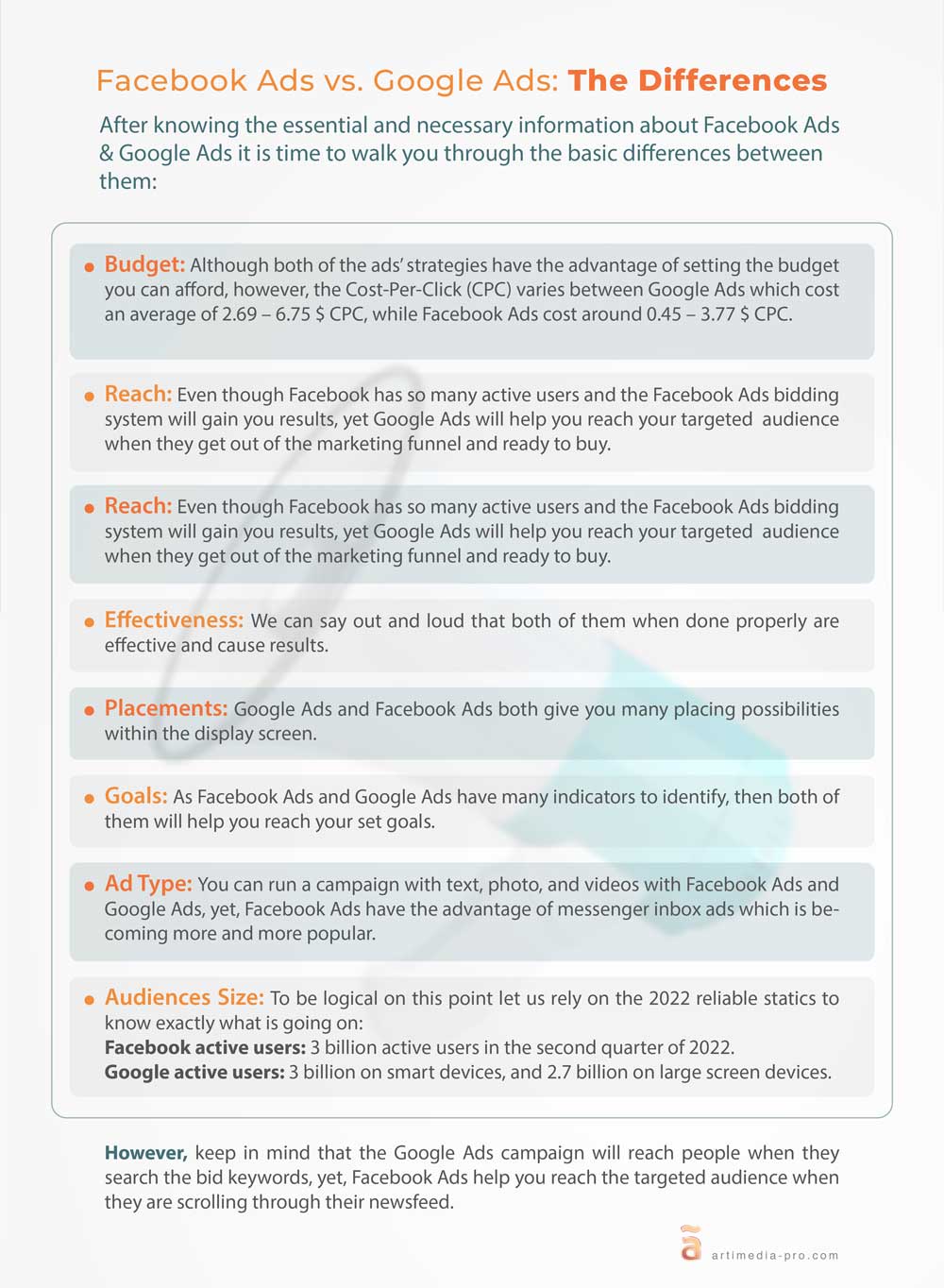
| Feature | Google Ads | Meta Ads (Facebook & Instagram) |
|---|---|---|
| User Intent | High (Active Search): Users are actively looking for a specific product, service, or answer. | Low (Passive Discovery): Users are browsing social media for entertainment or connection, not necessarily to buy. |
| Targeting | Keyword-based: Targets users based on the search terms they enter into Google. Also offers audience targeting. | Audience-based: Targets users based on demographics, interests, behaviors, connections, and custom audiences. |
| Cost | Generally a higher Cost Per Click (CPC) due to higher intent and competition for valuable keywords. | Often a lower Cost Per Click (CPC) and Cost Per Mille (CPM), making it cost-effective for brand reach. |
| Ad Formats | Text-based search ads, Display ads (images), Shopping ads, YouTube video ads, App ads. | Image ads, Video ads, Carousel ads, Collection ads, Stories ads, Lead ads. Highly visual and interactive. |
| Best For | Lead generation, sales, targeting customers with high purchase intent, local services (e.g., “plumber near me”). | Brand awareness, community building, generating demand for new products, e-commerce, retargeting website visitors. |
| Platform Reach | Google Search Network, YouTube, Gmail, Google Display Network (millions of websites and apps). | “Facebook, Instagram (see our Instagram best practices guide), Messenger, WhatsApp, and the Audience Network. |
When to Choose Google Ads
You should prioritize Google Ads when your primary goal is to capture immediate demand and drive sales from customers who are ready to buy.
You Have a Solution to an Existing Problem
If people are actively searching for what you sell, Google Ads is your best bet. Think of services like “emergency plumbing,” “digital marketing services in Syria,” or products like “buy organic coffee beans.” Your ad appears at the exact moment of need, providing a direct path to conversion.
High-Value Leads are Your Goal
For B2B companies or businesses selling high-ticket items, the intent-driven nature of Google Search Ads is invaluable. You can target specific, long-tail keywords that indicate strong commercial intent, ensuring your budget is spent on reaching the most qualified prospects.
You Need to Drive Local Foot Traffic
Google Ads is exceptionally powerful for local businesses. For entrepreneurs running Google Ads in Syria or across the MENA region, you can target location-specific searches like ‘best restaurant near me’ or ‘digital marketing services Damascus’ to appear in local search results and on Google Maps, driving customers directly to your physical location.Managing Google Ads campaigns effectively requires expertise in keyword research, bid strategies, and ongoing optimization. If you’re ready to leverage Google Ads for your business but need professional support, explore our Google Ads management services designed specifically for startups and businesses in the MENA region.
Google Ads vs Facebook Ads Management for Startups: Which Requires Less Expertise?
For startups with limited marketing resources, ease of management matters. Google Ads typically requires deeper keyword research skills and ongoing bid optimization, making it more technical. Meta Ads (Facebook Ads) offers more intuitive audience targeting through demographics and interests, which many startup founders find easier to grasp initially. However, both platforms benefit from professional management. If you’re weighing Google Ads vs Facebook Ads management for startups, consider starting with Meta for brand awareness while you build internal expertise, then adding Google Ads as you scale and can afford dedicated management or agency support.
When to Choose Meta Ads
Meta Ads excels at creating demand and building a relationship with your audience over time. It’s the platform of choice for visual brands and those looking to grow a community.
You are Building a Brand
If your goal is building brand awareness for a new, innovative, or visually appealing product, Meta Ads is the perfect place to introduce it to the world. Through engaging video and image ads, you can tell your brand’s story and capture the attention of a massive audience on Facebook and Instagram. Learn more about leveraging the power of social media ads for brand building and customer engagement. This is especially effective for fashion, food, and consumer goods.
Your Target Audience is Well-Defined
Meta’s powerful targeting options allow you to build detailed audience profiles. You can target users by age, location, interests (like “startups” or “entrepreneurship”), and even behaviors (like “frequent online shoppers”). This precision helps you get your message in front of the right people, even if they’ve never heard of you.
Your Budget is Limited
While costs vary, Meta Ads can often provide more reach and engagement for a smaller budget compared to highly competitive keywords on Google. This makes it an attractive starting point for startups and small businesses looking to make an impact without breaking the bank.
The Winning Strategy: Using Both Google and Meta Ads
The most successful digital marketing strategies don’t pit Meta vs. Google Ads against each other; they use them together.
Imagine this scenario:
- Awareness (Meta): A user in the MENA region sees your engaging video ad on Instagram for a new project management tool at the top of the marketing funnel. They are intrigued and visit your website but don’t sign up.
- Consideration (Google): A week later, they realize they need a better way to manage their startup. They search Google for “best project management software for startups.”
- Conversion (Google): Your Google Search Ad appears at the top. Recognizing your brand from Instagram, they click the ad and sign up for a free trial.
By combining the demand generation power of Meta with the demand-capturing power of Google, you create a comprehensive funnel that guides customers from discovery to purchase. This multi-channel approach is a cornerstone of effective digital marketing strategy that integrates paid, owned, and earned media.
Frequently Asked Questions (FAQs)
Is Google Ads cheaper than Meta ads?
It depends. The Cost Per Click (CPC) can be higher on Google Ads for competitive keywords because the user’s intent to buy is stronger. However, Meta Ads can sometimes lead to a higher overall cost to acquire a customer if your ads aren’t well-targeted. Generally, Meta is considered more cost-effective for generating broad awareness and reach, while Google can provide a better return on investment for direct sales if optimized correctly.
What is the difference between Google and Meta?
Google is primarily a search engine that connects users with information they are actively seeking. Its advertising platform (Google Ads) capitalizes on this search intent. Meta is a social media conglomerate (owning Facebook, Instagram, etc.) that connects people with each other. Its advertising platform (Meta Ads) uses user data to show relevant ads to people based on their profiles and interests.
Is $10 a day enough for Facebook ads?
Yes, $10 a day can be enough to start with Facebook (Meta) ads, especially for testing and learning. For this budget, you can run a campaign to drive traffic, build brand awareness in a specific local area, or retarget a small group of website visitors. While you won’t reach millions, it’s a sufficient amount to gather data, see what works, and begin generating results for a small business or startup.
How much do 1000 clicks cost on Facebook?
The cost of 1,000 clicks on Facebook varies widely based on your industry, target audience, ad quality, and campaign objective. The average CPC on Facebook can range from $0.50 to $3.50. Therefore, 1,000 clicks could cost anywhere from $500 to $3,500. However, for campaigns focused on brand awareness in less competitive markets, the cost could be significantly lower.
What is the main difference between Google Ads and Meta Ads?
The main difference between Google Ads and Meta Ads is user intent. Google Ads captures demand by showing ads to people actively searching for products or services (high intent), while Meta Ads creates demand by showing ads to people based on their interests and demographics as they browse social media (low intent, passive discovery). Google is ‘pull’ marketing—users pull information by searching. Meta is ‘push’ marketing—you push your message to a defined audience. This fundamental difference determines which platform works best for your specific goals
Conclusion
The debate over Google Ads vs Meta Ads isn’t about finding a single winner. It’s about understanding your unique business goals and leveraging the strengths of each platform.
- Choose Google Ads to capture existing demand and drive immediate sales from high-intent customers.
- Choose Meta Ads to build brand awareness, create new demand, and engage a highly targeted audience.
For most businesses in Syria and the MENA region, the ultimate path to growth involves a smart combination of both. Start by analyzing your goals, understanding your customer, and testing each platform to see what drives the best results for your brand.