
You’re posting every day. You’re crafting captions, designing graphics, and showing up consistently but your reach is shrinking, your follower count is stagnant, and sales from social media feel like a distant dream. Sound familiar?
Here’s the truth no one tells you upfront: social media success in 2026 isn’t about choosing between organic or paid it’s about understanding when each one works, why each one matters, and how to combine them into a strategy that actually grows your business.
Whether you’re a startup in Damascus, a growing brand in Dubai, or an entrepreneur anywhere across MENA this guide breaks down everything you need to know about organic vs. paid social media marketing, with real stats, actionable insights, and a clear path forward.
What Is Organic Social Media?
Organic social media refers to all the content you publish on your social channels without paying for distribution. It’s the everyday posts, Reels, Stories, threads, carousels, and videos you share to connect with your existing audience your followers, fans, and community.
Organic content is how brands build personality, trust, and long-term relationships. It includes customer replies, community management, user-generated content (UGC), and anything you share that grows through natural engagement likes, shares, comments, and saves.
Examples of organic social media activity include: posting a behind-the-scenes video on Instagram, sharing a product update on Facebook, engaging with comments on LinkedIn, or going live on TikTok to answer customer questions.
Organic social is your brand’s voice it’s what people see when they visit your profile, and it shapes whether they trust you enough to buy from you.
What Is Paid Social Media?
Paid social media is any content you pay to promote on social platforms. This includes boosted posts, display ads, video ads, sponsored content, carousel ads, lead generation ads, and retargeting campaigns all targeting specific audience segments defined by demographics, interests, location, behavior, or custom data.
Unlike organic posts that reach only existing followers (and even then, only a fraction of them), paid social media puts your content in front of people who’ve never heard of your brand but are highly likely to be interested in what you offer.
Paid social runs across platforms including Facebook, Instagram, TikTok, LinkedIn, Snapchat, Pinterest, and X (formerly Twitter). Each platform has its own ad manager, targeting options, and pricing model.
The biggest advantage of paid social is control and scale: you decide exactly who sees your content, when, and how often and you can start seeing results within hours of launching a campaign.
Organic vs. Paid Social Media: Key Differences at a Glance {#differences}
| Factor | Organic Social | Paid Social |
| Cost | Free (but time-intensive) | Requires ad budget |
| Reach | Limited to followers + algorithm | Targeted, scalable, unlimited |
| Speed | Slow grows over time | Immediate results |
| Trust | Higher feels authentic | Lower clearly labeled as “ad” |
| Targeting | No targeting control | Precise demographic targeting |
| Longevity | Content stays visible long-term | Stops when budget runs out |
| Best for | Brand building, community, loyalty | Lead gen, sales, launches |
| Measurability | Limited analytics | Detailed performance data |
| Algorithm dependency | Very high | Low you pay for placement |
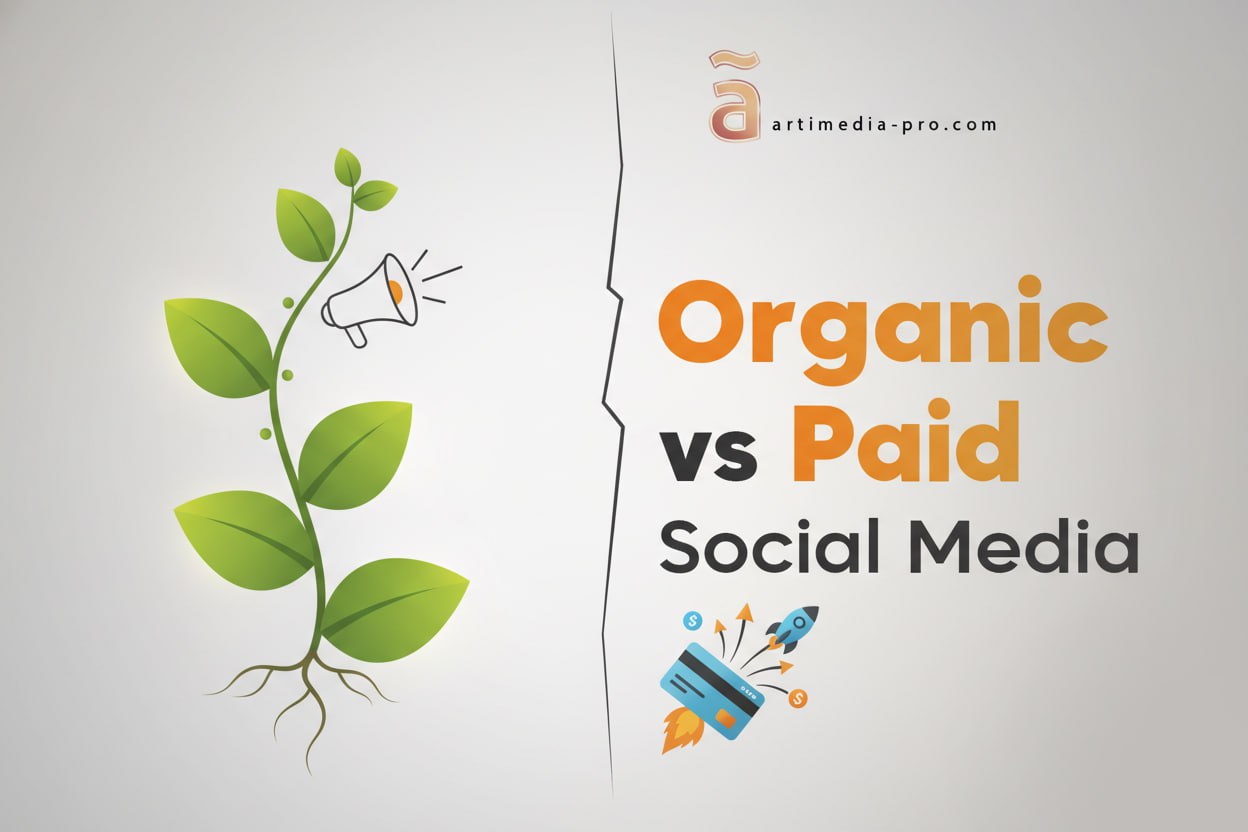
The key takeaway: organic and paid are not competitors they serve different but complementary purposes.
The Brutal Truth About Organic Reach in 2026
Let’s be direct about something most marketing blogs sugarcoat: organic reach is in steep decline, and it’s not coming back to what it once was.
Facebook’s organic reach across 2024 measured just 1.37%, with engagement sitting at a median rate of 0.2%. To put that in perspective: if your business Facebook page has 10,000 followers, your average post reaches roughly 137 people. That’s not a typo.
In 2026, the average organic reach on Facebook is approximately 1.65% of followers, and on Instagram, it’s around 3.50%. Even with a healthy following, the vast majority of your audience will never see your posts.
Meanwhile, social media advertising spending is projected to grow 18.9% to $268.7 billion worldwide a clear signal of where the industry is heading.
TikTok saw a 50% drop in organic engagement in 2024, while Instagram’s engagement rate has slid to around 0.50% per post year-over-year. Even TikTok, the darling of organic content, is tightening its algorithm.
Why is this happening? Social media platforms are businesses. Their revenue model is built on advertising. As more brands compete for attention, platforms naturally prioritize paid placements. The result is an increasingly “pay-to-play” ecosystem especially on Facebook and Instagram.
This doesn’t mean organic is dead. It means organic alone is no longer enough for most businesses serious about growth.
When to Use Organic Social Media
 Despite declining reach, organic social media remains essential for certain goals. Use organic when you want to:
Build brand identity and trust. Organic content is where your brand’s personality lives. It’s how you show the world who you are, what you stand for, and why people should care. 92% of consumers trust user-generated content more than traditional advertising (Nielsen, 2024) and that trust is built through consistent, authentic organic presence.
Nurture your existing community. Replying to comments, celebrating customer wins, and sharing community content costs nothing but time and it builds the kind of loyalty that no ad can buy. Your most loyal customers came from consistent organic nurturing, not a single paid campaign.
Test content before investing budget. Organic is the perfect testing ground. Post variations of your messaging, see what resonates, and then amplify the winners with paid. This approach reduces ad spend waste significantly.
Content that has a long shelf life. Tutorials, how-to guides, thought leadership posts, and evergreen educational content perform well organically over time especially on LinkedIn and YouTube where search plays a role in content discovery.
When budget is limited. For early-stage startups and entrepreneurs who can’t yet afford substantial ad budgets, organic is often the first step and when you have some budget, you then think about both strategies together.
When to Use Paid Social Media
 Paid social media becomes essential when your goals require speed, scale, or precision. Use paid social when you want to:
Launch a new product or service. Organic reach alone won’t generate enough awareness fast enough for a launch. Paid puts your offer in front of a targeted audience immediately exactly when it matters most.
Drive website traffic and leads. Paid campaigns with compelling CTAs and optimized landing pages are significantly more effective at driving measurable traffic and qualified leads than organic posts. This is where paid delivers clear, trackable ROI.
Retarget warm audiences. One of the most powerful features of paid social is the ability to retarget users who visited your website, engaged with your content, or abandoned a cart. These are the highest-converting audiences you can target.
Scale what’s already working. When an organic post is performing well getting real engagement, clicks, and saves boosting it with paid spend multiplies results without creating anything new.
Enter a new market or geographic area. If you’re expanding into new regions within MENA or targeting new customer segments, paid social lets you reach those audiences immediately with precise location and demographic targeting.
The average cost per click (CPC) on Facebook was $1.20 in early 2026, while LinkedIn CPC ranged between $5–$7 depending on the industry (WordStream, 2026) making paid social one of the most cost-efficient channels when managed well.
Organic vs. Paid: ROI Comparison
The ROI debate between organic and paid social media isn’t black and white it depends entirely on what you’re measuring and over what timeframe.
Short-term ROI: Paid wins. If you need sales or leads in the next 30 days, paid social delivers faster, more measurable results. You can set a budget, launch a campaign, and start seeing data within 24–48 hours.
Long-term ROI: Organic wins. Building an engaged audience, strong brand recognition, and customer loyalty through organic content compounds over time. Unlike paid campaigns that stop the moment you stop spending, organic content continues to generate engagement and search discovery indefinitely.
The true ROI advantage: the combination. Hybrid strategy (organic + paid) shows better results than either approach alone a tourism company saw +189% reach by combining organic with minimal boosting, while a retail brand saw +40% impressions using carousels with Stories promotion.
According to the 2026 Sprout Social Index, 65% of marketing leaders emphasized the need to show how social media supports business goals meaning measurement and attribution across both organic and paid channels is now a boardroom priority. (Source: Sprout Social Index, 2026)
The smart budget split: Industry experts recommend allocating roughly 60–70% of your social media budget to content creation (fueling organic) and 30–40% toward amplification through paid though this varies by business stage, industry, and goals.
The Hybrid Strategy Why You Need Both
The most successful brands in 2026 don’t debate organic vs. paid they’ve solved the equation. They use a hybrid strategy that treats both as parts of a unified system.
Here’s how the hybrid strategy works in practice:
Step 1 Create organically. Post consistent, value-driven content that reflects your brand voice. Build your organic presence as your foundation of trust and community.
Step 2 Identify your winners. Monitor which organic content gets the highest engagement, saves, shares, or click-through rates. These are content signals that tell you what your audience genuinely connects with.
Step 3 Amplify with paid. Take your top-performing organic content and boost it with a paid budget to dramatically expand its reach. This eliminates guesswork from your ad creative strategy you’re amplifying what’s already proven.
Step 4 Retarget and convert. Use paid retargeting ads to reach users who engaged with your organic content or visited your website, moving them further down the funnel toward a purchase or inquiry.
Step 5 Feed learnings back into organic. What worked in your paid campaigns (winning headlines, creatives, CTAs) informs your future organic content strategy. The loop never ends it only improves.
This integrated approach is why brands like Glossier built multi-million dollar businesses: they cultivated authentic organic communities first, then used paid to scale. The organic gave them the credibility; the paid gave them the reach.
Platform-by-Platform Breakdown
Different platforms demand different organic-paid balances. Here’s what the data says in 2026:
Facebook: Organic reach sits at around 1.37–1.65%. Facebook is now primarily a paid platform for business reach. It remains the most important platform for advertisers globally and offers the most sophisticated ad targeting available. Invest more heavily in paid here.
Instagram: Organic reach is around 3.5–9.34% depending on content type. Reels continue to get above-average organic distribution. Instagram is a hybrid platform strong organic community building and effective paid advertising coexist. Use both actively.
TikTok: TikTok leads in organic engagement with a 2.5% rate in 2026 and still rewards viral content regardless of follower count. It remains the best platform for organic reach potential, especially for creative, authentic content. Paid TikTok ads also offer competitive CPMs.
LinkedIn: Organic reach is around 6.4% with engagement rates up to 3% in certain sectors. 77% of B2B marketers report LinkedIn as their top platform. For B2B businesses, service providers, and consultants across MENA, LinkedIn organic + paid is a powerful combination.
YouTube: Organic discovery through search is still strong on YouTube. Combined with YouTube Ads (pre-roll, in-feed), it offers excellent opportunities for businesses investing in video content.
Common Mistakes Businesses Make
Understanding the pitfalls is just as important as knowing the strategies. Here are the most common errors we see especially among entrepreneurs and startups in Syria and across the MENA region:
Common Mistakes Businesses Make:
Going all-in on organic and expecting fast results. Organic is a long game. If you need leads this month, you need paid. Don’t let “we’ll just post more” become an excuse to avoid investing in ads.
Running paid ads without a strong organic foundation. When potential customers click your ad and visit a page with five posts and no engagement, they bounce. Ads drive traffic to your profile organic content converts that traffic into trust.
Boosting random posts instead of strategic ones. Boosting a post just because it “looks good” wastes budget. Only boost content that has proven organic engagement or that directly supports a business goal.
Ignoring analytics. Both organic and paid generate rich data. Not reading that data and adjusting accordingly means you’re flying blind. Use platform analytics and tools to understand what’s working and why.
Treating every platform the same. The content, tone, format, and strategy that works on TikTok is different from LinkedIn. A blanket approach across all platforms delivers mediocre results everywhere.
Stopping paid ads the moment you see results. Many businesses pull back on ad spend right when their campaigns are building momentum. Algorithms need time to optimize patience and consistency are critical in paid campaigns.
FAQs
What’s the main difference between organic and paid social media?
Organic social media is free content you publish to connect with your existing followers, while paid social media involves paying to distribute ads or promoted content to targeted audiences beyond your followers. Both serve different purposes in a complete marketing strategy.
Is organic social media still worth it in 2026?
Yes but not as a standalone strategy. Organic social builds trust, brand identity, and community, which are essential foundations for any business. However, with organic reach averaging under 2% on most platforms, it must be paired with paid advertising to achieve meaningful reach and growth.
How much should I spend on paid social media?
There’s no universal answer, but a common starting point is $500–$1,500/month for small businesses and startups to test and optimize. What matters more than the total budget is how it’s allocated, targeted, and measured. Start small, test consistently, and scale what works.
Can I succeed with organic-only social media?
For very early-stage businesses with zero budget, starting organically makes sense. However, relying on organic alone as your growth strategy in 2026 will significantly limit your results especially on Facebook and Instagram where organic reach is below 2%.
Which platforms are best for organic reach?
LinkedIn and TikTok currently offer the best organic reach potential. LinkedIn is ideal for B2B and service-based businesses, while TikTok rewards creative, authentic content regardless of follower count.
How do I know when to boost a post?
Boost posts that: (1) already have strong organic engagement, (2) directly support a business goal like generating leads or driving website traffic, and (3) have a clear call-to-action. Don’t boost vanity content just for likes.
Does running paid ads hurt my organic reach?
The algorithm does NOT suppress post reach because they’re ads or sponsored, according to Instagram CEO Adam Mosseri in January 2026. Priority signals are watch time, likes, and shares not whether you’re running ads. Paid and organic algorithms operate separately.
FLUQs Friction-Inducing Latent Unasked Questions
“If I start running paid ads, will people trust my brand less?”
This is a real psychological friction point. The answer: only if your ads feel inauthentic. The solution is running ads that look and feel like your organic content native-style creative that doesn’t scream “advertisement.” Authenticity in ad creative is increasingly the competitive advantage.
“What happens to my paid results when I stop running ads?”
Your traffic, leads, and visibility stop almost immediately. This is why paid alone is not a sustainable long-term strategy. The organic content and email list you build alongside paid campaigns are your safety net they continue to work when the ad budget runs dry.
“How do algorithms actually decide who sees my organic content?”
Algorithms prioritize content that generates early engagement (within the first 30–60 minutes of posting), favors formats the platform is pushing (Reels on Instagram, short-form on TikTok), and rewards accounts with consistent posting history. Timing, format, and consistency matter as much as the content itself.
How artiMedia Pro Can Help
At artiMedia Pro, we understand that entrepreneurs, startup founders, and project owners don’t have time to become social media experts while also running their businesses. You need a clear strategy, consistent execution, and measurable results not theories.
Whether you’re in Damascus building your first digital presence, scaling a brand across the UAE, or looking to tap into MENA markets for the first time, we specialize in creating hybrid social media strategies that blend organic content and paid advertising into one cohesive, results-driven system.
Here’s what working with artiMedia Pro looks like:
We start by auditing your current social media presence and understanding your business goals. We then build a custom content strategy for organic growth consistent, brand-aligned, and audience-tested. We layer in paid campaigns that amplify your best content, target your ideal customers, and drive measurable outcomes like leads, website traffic, and sales. And we report on what matters: real business metrics, not vanity numbers.
Our team speaks your market. We understand the nuances of marketing in Syria, the MENA region, and beyond including cultural sensitivities, language considerations, Arabic-first creative, and the platforms that perform best in your specific geography.
Ready to stop guessing and start growing?
Contact artiMedia Pro today and let’s build a social media strategy that actually works for your business.
📚 External Resources Referenced