

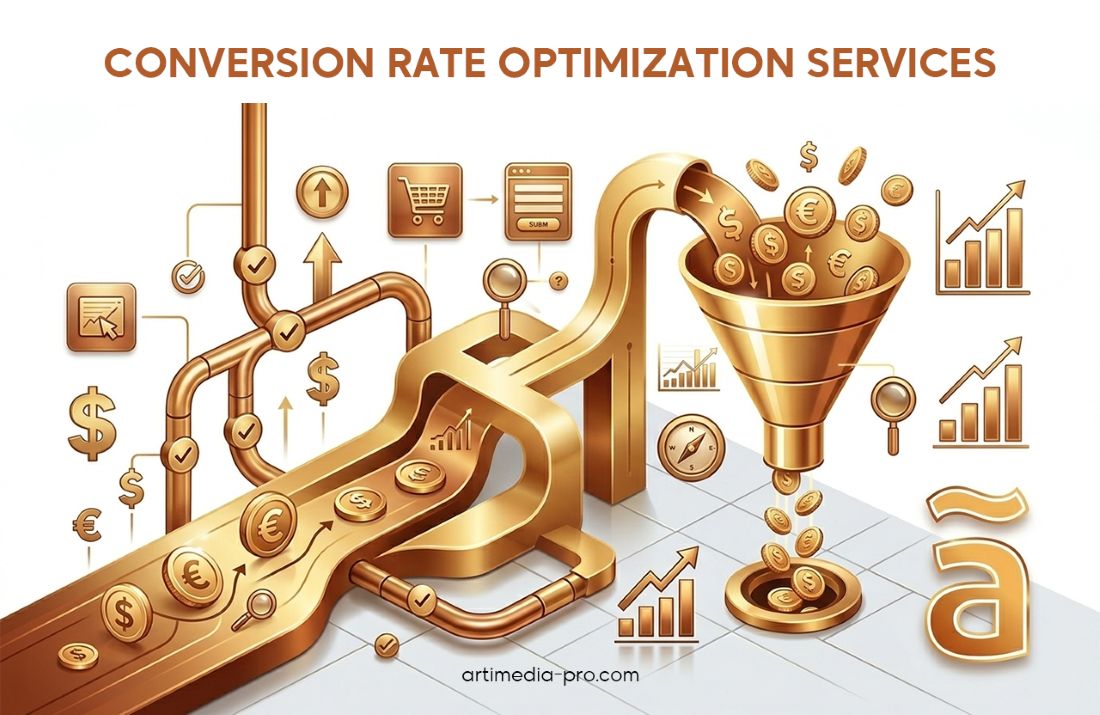

What Is Conversion Rate Optimization?
Conversion Rate Optimization (CRO) is the systematic process of increasing the percentage of website visitors who take a desired action whether that’s making a purchase, filling out a form, booking a consultation, or subscribing to a newsletter. It combines data analysis, user psychology, design thinking, and continuous testing to make every click count.
Think of your website as a physical store. You can spend a fortune on advertising to drive foot traffic. But if the store layout is confusing, the checkout line is too long, or the staff seem unhelpful most people will walk out empty-handed. CRO is the science of fixing the store, not just increasing the number of people who walk through the door.
The core formula is simple: Conversion Rate (%) = (Conversions ÷ Total Visitors) × 100. If 1,000 people visit your landing page and 30 complete a purchase, your conversion rate is 3%. CRO is about moving that number even by fractions of a percent to produce dramatically more revenue from the same traffic.
Why CRO Matters More Than Just Getting More Traffic
Most entrepreneurs and startup founders instinctively pour budget into traffic Google Ads, Meta campaigns, influencer partnerships. But here’s the brutal truth: traffic without conversion is just expensive noise. You’re renting attention and getting nothing in return.
The economics of CRO are staggering. According to research, companies spend just $1 on conversion optimization for every $92 they spend on acquiring new customers. This means the vast majority of marketing budgets are focused on filling a leaky bucket rather than plugging the holes. A professional conversion rate optimization company changes that equation entirely.
For startups and project owners operating with tight margins especially in markets like Syria and the broader MENA region CRO is not a luxury. It is the most capital-efficient growth lever available. Instead of scaling spend on ads that may not convert, you first fix your conversion engine, then scale with confidence.
A site loading in just 1 second converts at 3× the rate of a site that takes 5 seconds to load. Page speed alone is a major, often-overlooked conversion lever and it costs nothing to fix beyond developer time. (Landbase, 2026)
The Hidden Cost of Not Doing CRO
Every month you operate without CRO, you are leaving revenue on the table. If your site gets 10,000 visitors per month with a 1.5% conversion rate and an average order value of $80, you’re making $12,000 in monthly revenue. Improving the conversion rate to just 3% the global ecommerce average would bring that figure to $24,000. Same traffic, same product, same ads budget. Just a smarter website.
Beyond revenue, poor conversion rates also inflate your Customer Acquisition Cost (CAC). When fewer visitors convert, every sale costs more in advertising spend. CRO compresses CAC, which improves unit economics across every other channel you use making your paid campaigns, SEO, and social media all perform better simultaneously.
What Do Conversion Rate Optimization Services Actually Include?
When you hire a conversion rate optimization company, you’re not getting a one-off redesign or a single A/B test. You’re buying a systematic, ongoing methodology. Here is a breakdown of what comprehensive CRO services look like in practice.
- Conversion Audit & Heuristic AnalysisA deep diagnostic of your current site using frameworks like LIFT (Value Proposition, Clarity, Urgency, Anxiety, Distraction) to pinpoint exactly where users are dropping off and why before a single test is run.
- Quantitative Data AnalysisMining your Google Analytics, Hotjar, or similar tools to find pages with high exit rates, poor engagement, and low scroll depth. Data tells you what is happening; the next step reveals why.
- User Research & Qualitative InsightsSurveys, session recordings, user interviews, and heatmap analysis to understand the psychology behind user behavior. This is where CRO becomes an art, not just a science.
- A/B & Multivariate TestingRunning controlled experiments on headlines, CTAs, layouts, images, form lengths, pricing displays, and more. Each test is a question; statistical significance gives you the definitive answer.
- Landing Page OptimizationBuilding or revamping high-intent pages to align message, design, and offer with visitor intent. Businesses with 15+ landing pages generate 55% more leads than those with fewer than 10.
- Checkout & Funnel OptimizationReducing friction at every step of the purchase or sign-up flow from form field reduction to trust badge placement to one-click payment solutions that can lift conversion by up to 50%.
- Personalization & Dynamic ContentDelivering tailored experiences based on traffic source, location, device, or past behavior. AI-powered personalization is now used by 68% of CRO professionals and boosts conversions by an average of 23%.
- Mobile CROSpecifically optimizing the mobile experience where 60% of traffic arrives but conversion rates lag at just 1.6% versus 3% on desktop. Closing this gap is one of the highest-leverage CRO moves available.
How to Choose the Right Conversion Rate Optimization Company
The CRO market is crowded with agencies that promise transformative results without the methodology to back it up. Knowing what separates a genuine conversion rate optimization company from a generic web design shop will save you significant time and budget.
What a Credible CRO Partner Looks Like
The right agency starts with research, not solutions. Before recommending a single change, they should spend time understanding your customers, your funnel, and your business model. An agency that immediately jumps to “redesign your homepage” without data is selling opinions, not optimization.
Look for agencies that demonstrate a structured testing process: a clear hypothesis for each test, a defined success metric, a minimum sample size for statistical significance, and a post-test analysis that goes beyond “variant B won.” The best CRO companies document their learning and use it to inform future experiments building institutional knowledge over time.
Key Questions to Ask Any CRO Agency
- What is your testing process from hypothesis to implementation?A structured answer reveals genuine methodology versus ad-hoc guessing.
- How do you handle inconclusive tests?Most A/B tests don’t produce a clear winner. A good agency knows how to extract value even from “failed” experiments.
- How do you measure ROI from CRO?They should tie optimization efforts directly to revenue metrics, not just conversion rate numbers in isolation.
- Can you show case studies from a similar industry or market?Experience in your vertical especially relevant for businesses targeting MENA audiences matters significantly.
Conversion Rate Optimization Best Practices
 Whether you’re working with a CRO agency or building an in-house capability, these conversion rate optimization best practices represent the methods consistently proven to move the needle backed by data from industry leaders and real-world case studies.
Prioritize Page Speed
A one-second load time improvement can increase conversions by up to 7%. Target sub-2-second load times on all key landing pages and product pages.
Simplify Forms
Fewer form fields consistently produce more submissions. Removing even one unnecessary field from a lead generation form can produce double-digit conversion lifts.
Decision paralysis kills conversions. Pages with 40+ elements have less than half the conversion rate of pages with fewer than 10 elements. Focus every page on a single, clear action.
Reviews, testimonials, certifications, security badges, and client logos significantly reduce purchase anxiety especially for new visitors who have no prior relationship with your brand.
With 60% of traffic arriving on mobile but mobile converting at just 1.6% vs. 3% on desktop, mobile optimization is the single biggest untapped CRO opportunity for most businesses.
Your headline is the first and often only thing a visitor reads. A single word change in a headline can produce a 10–30% lift in conversions on high-traffic pages.
Product videos can increase purchase intent by up to 85%. Customer testimonial videos perform even better because they combine social proof with an emotional narrative.
Ethically deployed urgency limited-time offers, low stock indicators, countdown timers can meaningfully increase conversion rates without harming brand trust when used transparently.
B2B websites using real-time chatbots see a 20–25% boost in conversion rates during initial visitor sessions. Chat removes friction from the decision-making process in real time.
The CRO Process: A Framework That Works
Effective CRO follows a repeatable process, not a series of random guesses. The research-driven approach that separates elite CRO practitioners from amateurs follows this cycle: Research → Hypothesis → Prioritization → Testing → Analysis → Implementation → Repeat.
Prioritization is often overlooked. Not every test idea is worth running. Tools like the ICE Score (Impact, Confidence, Ease) help teams rank experiments so the highest-leverage opportunities are tested first. This prevents wasting months on low-impact changes while bigger wins go untested.
CRO for MENA Markets & Syrian Businesses
The MENA digital market is experiencing rapid growth, with e-commerce penetration accelerating across the Gulf, Levant, and North African markets. However, many businesses in the region particularly Syrian entrepreneurs and startups apply Western CRO frameworks without accounting for critical cultural and behavioral differences.
Arabic-language websites require right-to-left (RTL) design optimization, which affects everything from button placement to reading patterns to CTA positioning. A CTA that works perfectly on an LTR page may be completely overlooked when the layout is mirrored yet many agencies apply the same templates without adjustment.
Trust Signals That Work in MENA
Payment trust is a particularly significant CRO factor in MENA markets. Cash-on-delivery (COD) availability, local payment gateway logos, and WhatsApp-based customer support dramatically reduce purchase anxiety for audiences in countries where online payment adoption is still maturing. Simply adding a “Pay on Delivery” option with a clear, visible badge can produce conversion lifts of 15–40% in these markets.
Social proof also operates differently in high-context cultures like those across the Arab world. Peer recommendations, community validation, and influence from trusted community figures carry more weight than anonymous star ratings. CRO strategies for MENA should incorporate more social proof formats WhatsApp testimonials, video reviews in Arabic, and influencer endorsements rather than relying solely on written review widgets.
Mobile-first is not a best practice in MENA it is a baseline requirement. Smartphone penetration across MENA exceeds 90% in most markets, and the majority of browsing and shopping happens exclusively on mobile. Any CRO strategy that does not start with mobile is not relevant to this audience.
Frequently Asked Questions About CRO Services
1. What is a good conversion rate to aim for?
A “good” rate depends heavily on your industry and price point. As of 2026, here are the general benchmarks:
E-commerce Average: 2.5% – 3% is the standard. If you are over 4%, you are in the top tier of stores.
High-Performers (Beauty/Health): Can see rates as high as 6% – 7% due to repeat purchases.
High-Ticket (Furniture/Electronics): Often lower, around 1% – 2%, because the “consideration phase” is longer.
B2B Lead Gen: Aim for 3% – 5% for high-quality inquiry forms.
2. How long does it take to see results?
CRO is a marathon, not a sprint.
Quick Wins (1–4 weeks): Fixing technical bugs (broken buttons, slow mobile speed) can show immediate impact.
Statistical Significance (1–3 months): Proper A/B testing requires enough traffic to prove a winner. Most agencies run 2–4 week test cycles.
Full Program ROI (6+ months): This is when the compounding effect of multiple small wins starts to significantly move your baseline revenue.
3. Is CRO only for e-commerce?
No. CRO is for any site with a goal.
SaaS: Optimizing free-trial signups or “demo” requests.
B2B/Services: Optimizing lead forms, whitepaper downloads, or click-to-calls.
Content/Media: Optimizing newsletter signups or ad engagement.
4. What tools do CRO agencies typically use?
The modern “CRO Stack” usually includes:
Analytics: Google Analytics 4 (GA4) or Matomo.
Behavioral Tech: Hotjar or FullStory (Heatmaps and session recordings).
Testing Platforms: VWO, Optimizely, or Convert.com.
User Feedback: Lyssna or UsabilityHub for qualitative surveys.
5. How much do CRO services cost?
Pricing varies by the complexity and traffic of your site:
Low-End/Freelance: $1,500 – $3,000 /month.
Mid-Market Agency: $5,000 – $10,000 /month.
Enterprise: $15,000 – $30,000+ /month.
6. Can I do CRO without a big budget?
Yes. You don’t need expensive software to start.
Watch Recordings: Use a free tier of Hotjar to watch 100 people use your site. You’ll see exactly where they get stuck.
Fix “Friction”: Simplify your forms. Remove unnecessary fields.
Speed Up: Use free tools like PageSpeed Insights to find technical lags.
Copywriting: Changing a “Submit” button to “Get My Free Guide” costs $0 but can double clicks.
7. CRO vs. UX Design: What’s the difference?
They are two sides of the same coin:
UX (User Experience): Focuses on making the site easy and enjoyable. It asks: “Does the user understand how to use this?”
CRO: Focuses on making the site persuasive. It asks: “Does the user want to take the action we want them to take?”
8. Does social media drive high-converting traffic?
Generally, social media traffic has lower conversion rates than Search (SEO/Google Ads) because the user’s intent is different.
Search Traffic: High intent. They are looking for a solution now.
Social Traffic: Low intent. They were browsing memes and you interrupted them.
The Exception: Retargeting ads (showing an ad to someone who already visited your site) via social media usually has a very high conversion rate.
Stop Paying for Traffic That Doesn’t Convert
artiMedia Pro is a full-service digital marketing agency helping entrepreneurs, startups, and project owners across Syria and the MENA region unlock the revenue hiding inside their existing traffic. Our team combines global CRO methodology with deep regional market expertise so your optimization strategy actually fits your audience.
From conversion audits and A/B testing to full funnel redesigns and Arabic-language UX optimization, we build CRO programs that are measurable, sustainable, and built for your specific goals.